In illustrating the spirit of his vibrant surroundings, Ernest Hemmingway once described the “mad, whirling carnival” he saw around him in Spain. As an American studying at Madrid’s IE Business School I will be documenting my experience with this blog, dedicated to that theme.


For friends and family, you can find frequent updates on my life and adventures by checking back here regularly. For anyone else, I hope you find my posts on business school and life in Spain interesting.

_____________________________________________________________________________

Wednesday, June 30, 2010

4th of July event at the US embassy in Madrid


Me at the American Embassy 4th event


Simon at the event - thanks for the invite bro!!


The ambassador Alan Solomont presenting the stars and strips, and welcoming the invitees


"Lets party!"- closing remarks by Alan Solomont, US ambassador to Spain


Rock & roll and blues all night long, and some inspirational USA images to accompany


The ambassador dancing with his lovely wife - they are clearly having a great time


- Please excuse the brevity and typos. Posting from my iPhone

Location:Calle de Serrano,Madrid,Spain

Monday, June 28, 2010

First final down, and a good one!!

Final exam for Information Systems was today.


The professor (Enrique Dans) actually brought in the founders of the business case tested (spotCRAFT) to answer our questions.

VERY COOL!


- Please excuse the brevity and typos. Posting from my iPhone

Tuesday, June 22, 2010

Tesco Loyalty


Amongst loyalty programs, Tesco’s Club Card is considered to be the gold standard. The Club Card loyalty program is more than ten years old now and serves as a huge competitive advantage for Tesco. The brains behind Tesco’s Club Card program is an outside contractor – Dunnhumby.

What Dunnhumby did for Tesco was new for the industry, but not an entirely new concept all together. The idea of “loyalty programs” previously existed within the airline industry, however never before had a robust loyalty program been established for an industry with such frequent purchases as grocery. This allowed Tesco to obtain an enormous amount of information about its customers.

Soon after testing began on the Club Card program, Tesco's then-Chairman Lord MacLaurin, said "What scares me about this is that you know more about my customers after three months than I know after 30 years." The value of the loyalty program quickly became clear: loyalty programs’ competitive advantages exist in marketing intelligence.

With this new marketing intelligence Tesco was freed to engage with customers in new, personalized ways. Customers were offered discounts and coupons customized to their buying habits and also offered different discounts to encourage them to explore new products and categories. With this type of personalized marketing, soon loyalty to Tesco emerged within the UK market. If shoppers weren’t shopping at Tesco they were missing clear opportunities to save money.

Monday, June 21, 2010

Day trip to IE University Campus in Segovia


The next cover of the IE University Magazine... I'm sure of it!


Segovia from a distance


Only the best Roasted Suckling Pig in the world, served in this restaurant for over 250 years.

_____________________________________
More pictures...


- Please excuse the brevity and typos. Posting from my iPhone

Saturday, June 19, 2010

it's in the making of a decision

If nothing else an international MBA is a series of decisions. It is an intense training in decision making in a multi-cultural framework. There is very little structure in the academic program (which can be a shock because the huge cost of tuition seems to warrant structure in learning). Choices are negotiated and delegated amongst peers of diverse and disparate backgrounds.

This is not exclusive to the classroom. Imagine an event as basic as a dinner reservation with classmates. This is your crash course in negotiation and patience. Participating in a decision as simple as what to eat: with 100% A-type personalities with 100% confidence in their opinions with no common culture and no common native language – though we all want to eat, we will all suffer a short famine as we struggle to understand the meaning behind each others words and body language.

This is nothing like living in another country. This is nothing like learning another culture. This is dozens of countries and dozens of cultures all adapting to each other simultaneously. The actions of an Egyptians interacting with an Israeli can hardly represent the actions of that same Egyptian interacting with a Lebanese. With time you learn to separate the cultural differences from the personality differences. We separate the daily changes in mood from lasting personality, and we translate it through cultural frameworks. All differences in cultural fade away with time. We see that culture is only one data source amongst many.

My decisions, the dozens I make each day, are no longer consciously factoring in the cultural differences of the people around me. At some point the various cultures we all bring with us dissipate within the singular culture we create amongst us. We have our own culture. It has no nationality. No place of origin. It was created in real time, by real people, with real opinions. Our culture is the first of it’s kind and it will likely be the last of it’s kind.

We make decisions now based on OUR cultural framework, not on the framework we brought with us to Madrid. We make our decisions differently now. We make them with a different perspective. And we are all hoping to make the right decisions. At least I am hoping to make the right decision.

Share

Tuesday, June 15, 2010

ERP Systems - to implement or not to implement?


Ok, this is not my (nor any sane person’s) favorite topic to write about, but here it is.

Enterprise Resource Planning (ERP) systems SHOULD be the backbone or nervous system of every scaled multinational organization. They SHOULD be an asset, a competitive advantage, and a go-to storehouse for organizational history and long-term memory. This is what they SHOULD be… but the question is how often ARE they these things?

Companies like Oracle, Accenture, Sage & SAP secure their business models with the sale and promotion of all encompassing ERP systems. Since the “Y2K” scare, masses of consultants and programmers have built customized ERP systems on every continent, charging licensing fees and billing hours totaling in the billions of dollars every year. And yet with all this investment it is a real challenge to find someone with a positive ERP implementation story.

So, is the solution for organizations to avoid ERP systems all together? Well clearly not, as organizations require enterprise wide systems to function more efficiently. But it is to say that in practice the dream of a fix-all system that will solve problems rooted more realistically in communication, organizational design, and corporate culture is folly. ERP systems should be relayed on no more than individual employees – they have advantages and disadvantages and they will work for your firm for only a finite amount of time.


Monday, June 14, 2010

More pictures for The Canary Islands


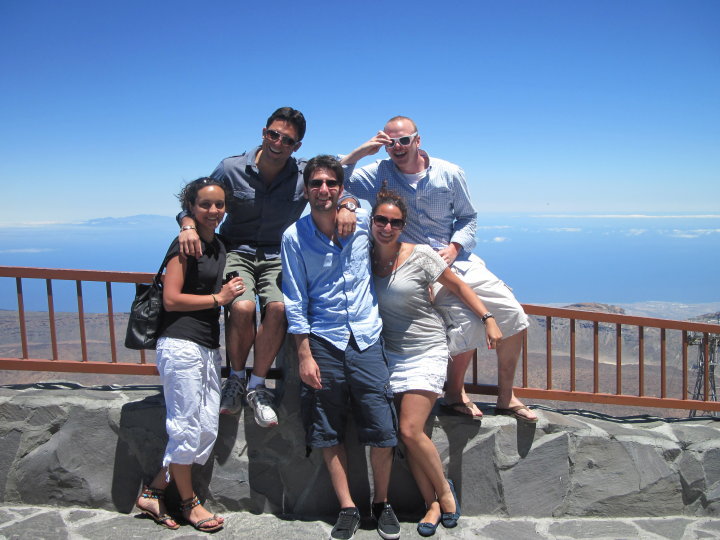
The Canary Islands Crew


Yup, that light blue dot is me in the middle of the lava field, heading up the mountain in flip flops


Building our own cairn on the Cairn Beach at night